The World's New Maps III: The Re-industrial Gamble
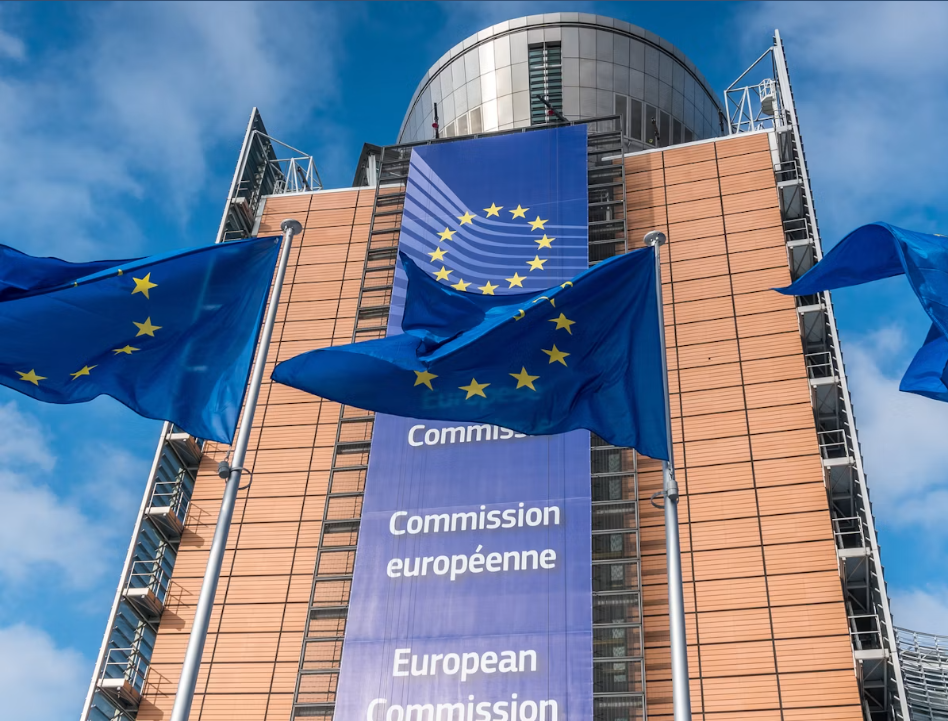
The Reindustrial Gamble
Europe is trying to legislate an industrial revival — can money and policy buy back what energy took away?
In the German city of Ludwigshafen, a company town of roughly 175,000 people, the mood is grim. BASF — the world's largest chemical company, and the reason the town exists — has been shutting plants and shedding thousands of jobs at the very site that has been its heart for 160 years. At the same time, it has been pouring roughly €10 billion into a vast new complex in China, its single biggest investment ever.
One company town tells the whole European story. For two decades, Europe quietly ran its industrial base on a bargain: cheap Russian gas, open Chinese demand, and American security. All three pillars have now cracked. And the continent that built the modern world's first factories is watching them, one by one, power down or move away.
The response has been the most ambitious industrial-policy push in Europe's postwar history — hundreds of billions of euros committed, constitutional rules rewritten, and a wholesale bet that the state can rebuild what the market let wither. This is the third piece in our series on how the global economy is being physically reorganized. In Part I, we looked at the Gulf building the roads of global trade; in Part II, at the Indo-Pacific building the factories. Europe is the mirror image — a region trying to rebuild factories it spent thirty years letting slip away. It is the supply-chain story running in reverse.
The question for investors is stark and simple: is this a genuine, investable revival — or an expensive act of fiscal denial against forces that policy cannot overcome?
Asia built its factories on cheap labour. The Gulf built its hubs on sovereign wealth. Europe is trying to legislate its comeback.
The Great Unwinding
To understand the gamble, you have to understand what broke. For a generation, the European industrial model — above all Germany's — rested on a formula that looked like genius and turned out to be a dependency. Energy-intensive industry ran on cheap, abundant Russian pipeline gas. Finished goods flowed to a fast-growing China that could not buy enough German cars and machines. And the entire edifice sat comfortably under an American security umbrella that let Europe spend on factories instead of defense.
Then 2022 happened. The conflict in Ukraine and the subsequent unwinding of Russian pipeline supply severed the cheap-gas pillar almost overnight. China evolved from Europe's best customer into its most formidable competitor — most visibly in electric vehicles, where it now out-competes the German champions in their own core market. And Washington began signalling, under successive administrations, that the security umbrella was no longer unconditional.
The damage is not theoretical. German industrial production now sits around 10% below its 2018 level, and energy-intensive output is roughly 15% below its early-2022 level. Foreign direct investment into Germany roughly halved in 2024, and surveys show a striking share of industrial firms now plan to invest abroad rather than at home. The roll-call of names cutting or relocating — BASF, Volkswagen, ThyssenKrupp, Bosch — reads like a directory of the postwar German miracle.
This is what makes Europe the reverse of the Indo-Pacific story. In Asia, we watched factories arrive. In Europe, we are watching them leave — and the whole reindustrial project is an attempt to reverse that current before it becomes permanent.
Energy: The Root of Everything
Strip away the politics and the press releases, and Europe's entire industrial problem reduces to a single number: the price of energy. This is the root from which everything else grows, and no amount of policy ambition can bypass it.
The gap is brutal. In 2024, industrial electricity in the EU cost around €0.199 per kilowatt-hour — against roughly €0.082 in China and €0.075 in the United States. Put plainly, European manufacturers have been paying more than double what their American competitors pay for power, and roughly 50% more than their Chinese rivals. The International Energy Agency confirms the gap persisted through 2025, with EU industrial power still averaging over twice US levels. For a steel mill, an aluminium smelter, or a chemical plant — businesses where energy is the largest single input — that is not a disadvantage. It is a death sentence, slow but certain.
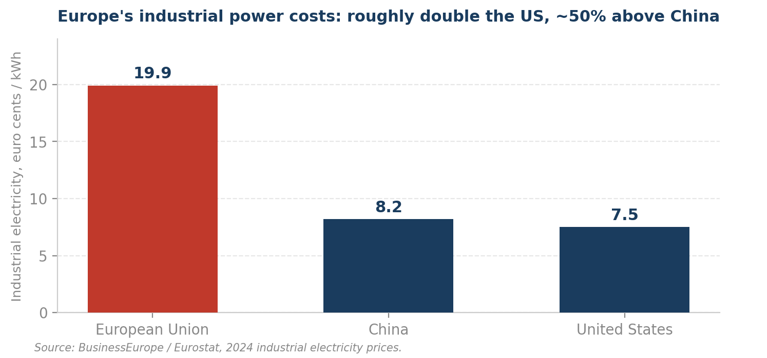
This is why BASF builds in China and Louisiana rather than Ludwigshafen. It is why energy-intensive production has been the first and hardest hit. And it is why every serious European reindustrialisation plan is, at its core, an energy plan. The continent is racing to solve the cost problem three ways at once: importing liquefied natural gas to replace Russian pipeline supply, accelerating a massive renewables and grid buildout, and — in a striking reversal of a decade of policy — rehabilitating nuclear power. Renewables already supply around half of EU electricity generation, and analysts project wholesale power prices could fall meaningfully by 2030.
But here is the hard truth for investors: even the optimistic projections do not close the gap with the US and China. They narrow it. Europe is not trying to win the energy-cost race — it cannot. It is trying to lose it by a small enough margin that its other advantages, in engineering, quality, and now subsidy, can compensate. Whether that margin is small enough is the entire investment question.
The Policy Engine
Here is what makes Europe genuinely different from the other regions in this series. Asia's factories were pulled by cheap labour and private capital. The Gulf's hubs were pushed by sovereign wealth. Europe has neither cheap inputs nor a sovereign chequebook — so it is attempting something far harder: to legislate an industrial revival into existence. Policy is not the backdrop to this story. It is the engine.
Three moves matter most. The first, and largest, is Germany's reversal of its constitutional "debt brake" in March 2025 — a genuinely historic change. It exempted defense spending above 1% of GDP from borrowing limits entirely, and created a €500 billion off-budget fund for infrastructure, €100 billion of it earmarked for climate investment, to be spent within twelve years. For a country whose entire political identity was built on fiscal restraint, this is the equivalent of a religious conversion.
The second is the EU's Clean Industrial Deal, unveiled in February 2025 — a sweeping framework that loosens decades-old state-aid restrictions (letting governments subsidise industry in ways previously forbidden), channels ETS carbon revenues into a proposed €100 billion Industrial Decarbonisation Bank, and pushes an electricity-market and grid overhaul aimed squarely at the cost problem.
The third — and the most relevant to our supply-chain thread — is the Carbon Border Adjustment Mechanism, or CBAM. This is a carbon tariff: it charges importers for the emissions embedded in goods like steel, cement, aluminium and fertiliser, so that products made under Europe's strict (and expensive) carbon rules are not undercut by cheaper, dirtier imports. In effect, it is a wall built around European heavy industry — and a direct attempt to make "made in Europe" viable again. A comprehensive review through 2025 is being followed by a further legislative proposal in 2026, so its real shape is still forming.
Big money has been committed. The harder question is whether 27 countries can spend it as one.
And that is the catch. Committing capital is the easy part; deploying it coherently is not. The EU is not one actor but twenty-seven, each with its own industrial interests, energy mix, and fiscal position. France wants nuclear; Germany spent years dismantling it. Southern states want transfers; northern ones resist them. The money is real, but the machinery to spend it as a single strategic bloc is not. This is the European version of the question we asked of the Indo-Pacific — the ambition is visible; the execution is the variable.
Where It Is Investable — and Where It Isn't
For investors, the reindustrial gamble does not divide neatly into "buy Europe" or "avoid Europe." It divides by whether a given sector is on the right or wrong side of the energy-cost gap. Our framework is simple: follow the money that solves a real problem, and avoid the money that is merely fighting physics.
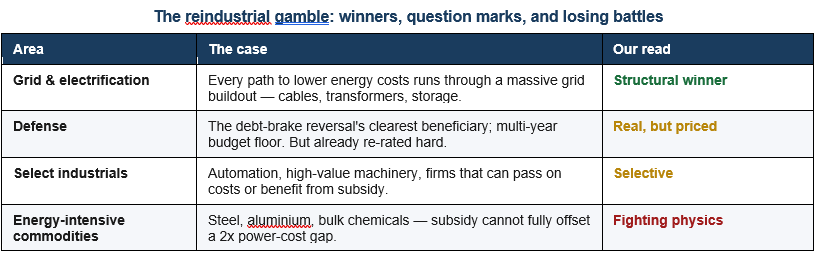
The grid is the clearest structural winner. Whatever else happens, Europe cannot lower its energy costs, integrate renewables, or electrify industry without an enormous investment in the electricity network itself — the cables, transformers, substations and storage that most people never think about. This is the picks-and-shovels layer of the entire energy transition, and it benefits regardless of which energy source ultimately wins. It is the part of the European story least dependent on getting the hard calls right.
Defense is the most obvious beneficiary of the fiscal shift, but also the most fully priced. As we explored in a dedicated piece earlier this year, the debt-brake reversal and NATO spending commitments have created a genuine multi-year demand floor. But the market has understood this for over a year: Rheinmetall rose roughly 400% over three years, and in 2026 the sector has entered what analysts call a consolidation phase — the easy gains made, investors now "picky and selective." Real theme, demanding entry price.
The area to approach with genuine caution is energy-intensive heavy industry — the steel, aluminium, and bulk-chemical businesses at the heart of the old model. Here, subsidy and carbon walls are fighting a cost gap that physics and geography impose. CBAM may protect these industries at home, but it cannot make them globally competitive, and it risks raising costs for every European manufacturer downstream that uses their output. This is where reindustrialisation is most likely to become expensive life support rather than revival.
For most clients, the cleanest way to express a constructive-but-selective view is through broad Eurozone exposure — a vehicle such as the SPDR Euro STOXX 50 (FEZ), heavily weighted to French and German industrial and financial leaders — rather than narrow thematic bets, complemented by targeted exposure to the grid and electrification supply chain where the structural case is strongest. The broad index has meaningfully outperformed the narrow defense basket in 2026, a reminder that in a policy-driven revival, breadth often beats the obvious headline trade.
What Could Go Wrong
The energy gap may simply never close enough. This is the risk that sits underneath all others. If European power stays structurally twice as expensive as America's, no amount of subsidy or carbon protection will make energy-intensive industry globally competitive. The reindustrial project would then become a very costly way of slowing decline rather than reversing it — propping up plants that never regain their edge.
Fragmentation could squander the firepower. The money is committed at the national and EU level, but Europe has a long history of announcing grand strategies and then diluting them across twenty-seven competing agendas. If the capital is spread as political appeasement rather than concentrated where it can actually win, the entire gamble underdelivers — big spending, small return.
Subsidy competition could turn into a race Europe loses. The US (through its own industrial-policy spending) and China (through overwhelming manufacturing scale) are subsidising many of the same industries. Europe risks entering a subsidy war against competitors with deeper pockets and cheaper energy — a contest in which matching spending still leaves it structurally behind.
A continent betting that policy can outrun physics.
Europe's reindustrial gamble is the boldest state-led economic bet of the decade — an attempt to legislate back into existence an industrial base that cheap energy and open trade quietly hollowed out. The money is real. The urgency is real. The policy ambition is genuinely historic. But the energy-cost gap that caused the problem has not gone away, and no law can repeal the price of a kilowatt-hour.
For investors, that argues for a specific posture: constructive on the parts of the story that solve a real problem — the grid, electrification, selective industrials — and skeptical of the parts that are simply fighting physics with subsidy. Europe will not rebuild the world it lost. The question is whether it can build a smaller, more resilient one in its place.
With that, our map has three regions on it — the Gulf's roads, the Indo-Pacific's factories, and Europe's attempted revival. In the final piece of this series, we will bring them together: what the world's new supply-chain map means as a whole, how the three regions connect, and how a portfolio should be positioned for a world that is being physically rewired — one factory, one port, and one policy at a time.

