Beyond Returns: How Strong Funds Control Risk

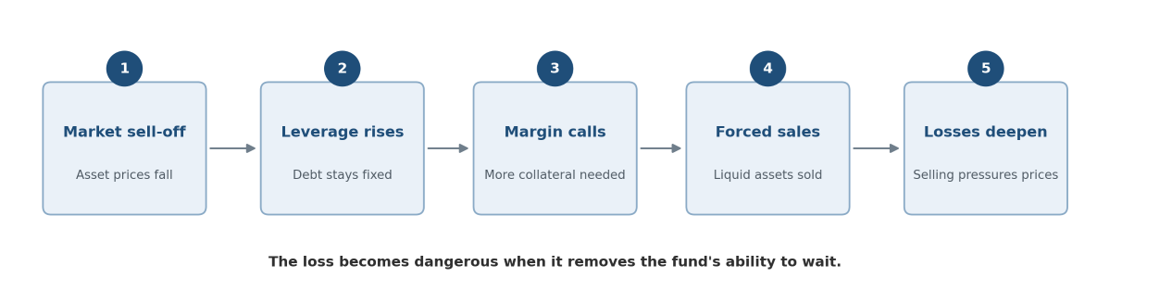
At the height of a market sell-off, a fund manager may face three problems at once: falling asset prices, rising margin calls and investors asking for their money back. Even a sound investment thesis can become irrelevant if the fund no longer has enough liquidity to wait.
This is where risk management proves its value. Its purpose is not to prevent every loss, but to ensure that one bad position or market shock does not force the fund to sell at the worst possible moment. Strong funds manage this through disciplined position sizing, diversification, leverage controls, hedging, stress testing and liquidity planning.
1. Why Risk Management Matters
Every fund must accept risk to earn a return. The objective is not to remove uncertainty, but to keep losses within a range the portfolio can absorb. Two funds can report the same annual return while taking very different paths to achieve it. One may rely on moderate positions, limited leverage and several independent return drivers. Another may depend on a small group of correlated securities financed through derivatives. The headline performance can look identical even though the second fund is much more vulnerable to a sudden change in rates, liquidity or investor sentiment.
For illustration, consider a hypothetical fund with US$100 million of investor capital and US$50 million of borrowing. It holds US$150 million of assets, or 1.5 times assets to equity. If the assets fall by 15%, their value declines to US$127.5 million while the debt remains US$50 million. NAV falls to US$77.5 million and the ratio rises to about 1.65 times without the manager adding any exposure. A market loss has become a funding problem. If the lender demands more collateral, the fund may have to sell assets into a falling market. If investors are redeeming at the same time, the liquidity pressure becomes more severe.
Large drawdowns also damage compounding. A 10% loss requires an 11.1% gain to recover; a 30% loss requires 42.9%; and a 50% loss requires 100%. Risk management therefore protects more than the current NAV. It protects the capital base from which future returns are earned.

Under the SFC’s October 2024 Fund Manager Code of Conduct, a fund manager should maintain a satisfactory risk-management governance structure and procedures commensurate with the nature, size, complexity and risk profile of the firm and the investment strategy adopted by each fund. At fund level, managers should implement procedures to identify, measure, manage and monitor risks relevant to each strategy, including market, liquidity, counterparty and other material risks such as operational risk.
2. Diversification Is About Risk, Not the Number of Holdings
A portfolio can hold dozens of securities and still behave like one large trade. The key question is not how many names appear on the holdings list, but how many independent economic drivers sit behind them.
ARK Innovation ETF is a useful illustration. Under normal circumstances, ARKK invests at least 65% of its assets in domestic and foreign equity securities of companies relevant to disruptive innovation. It is classified as non-diversified, allowing a relatively high proportion of assets to be invested in a smaller number of issuers. ARK’s current fund overview identifies areas including intelligent devices, autonomous mobility, precision therapies, neural networks, next-generation cloud and digital wallets. The businesses are different, but many high-growth companies share exposure to real interest rates, access to capital and investor appetite for long-duration assets.
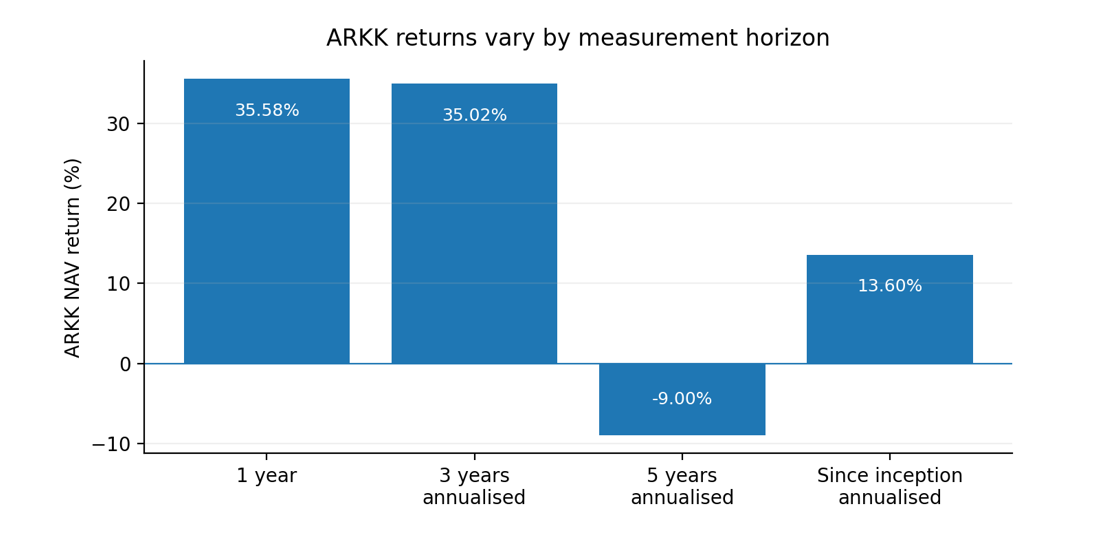
The numbers show how sensitive the return path can be. According to ARK, ARKK’s NAV returned 35.58% in 2025, while its five-year annualised NAV return through 31 December 2025 remained negative 9.00%. In an ARK Capital Markets note, ARKK’s NAV was reported to have returned 73.54% from the close on 8 April to the close on 24 June 2025, compared with 29.74% for the Nasdaq-100 Index over the same period. These figures do not prove that every holding is driven by the same factor, but they do show that a thematic portfolio can move far more aggressively than a broad index in both directions.
The lesson is not that concentrated thematic investing is necessarily poor investing. Concentration can be intentional and profitable. The risk-management task is to identify the shared drivers and decide how much of the portfolio should depend on them. An investor should ask which holdings would fall together if real yields rose, funding markets tightened or enthusiasm for the dominant theme faded.
3. Position Size and Leverage Determine the Cost of Being Wrong
Investment selection decides what to own; position sizing decides how much damage a mistake can cause. A manager should consider expected upside, realistic downside, trading liquidity, correlation with the rest of the portfolio and the time required for the thesis to develop. A 20% position that falls by 50% reduces fund NAV by 10% before any movement in the rest of the portfolio. If several large positions share the same factor, the effective concentration is even greater.
Static limits are not enough because risk changes even when portfolio weights do not. A 5% position becomes more dangerous when its volatility rises, market depth falls or its correlation with other holdings increases. Strong managers therefore estimate how quickly a position can be reduced under both normal and stressed trading volumes before they enter it.
Leverage adds another layer because borrowed capital has its own timetable. An unleveraged investor can wait through a temporary decline. A leveraged fund must also meet margin calls and financing maturities. A manager can be right over three years and still be forced out in three days.
Net exposure alone can also be misleading. A long-short fund with 150% long exposure and 130% short exposure has only 20% net exposure but 280% gross exposure. It can lose heavily if the long book falls while the short book rises, if paired relationships break down or if short-borrow costs increase. A sound framework therefore monitors gross and net exposure, derivative notionals, collateral terms, counterparty concentration and the amount of cash required under higher margin assumptions.

The key stress-test question is not only how much the fund could lose, but how much liquidity it would need while losing it. A portfolio may have enough NAV to survive a mark-to-market decline yet lack the cash or eligible collateral required to meet a call within two days.
4. Hedging Should Preserve the Ability to Act
The strategic purpose of a hedge is not to make the portfolio risk-free. It is to protect a vulnerability that could otherwise force the manager into an unwanted sale.
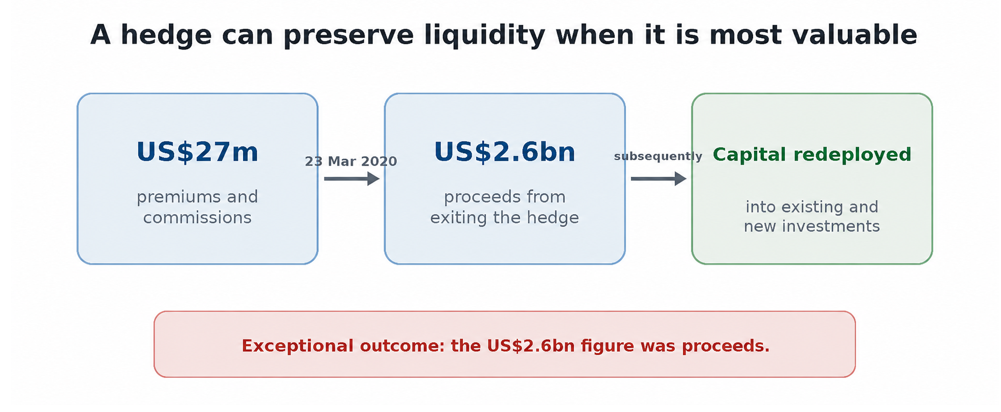
In early 2020, Pershing Square purchased credit protection on various global investment-grade and high-yield credit indices. On 23 March, it completed the exit of the hedges, generating US$2.6 billion of proceeds for the Pershing Square funds, of which US$2.1 billion was attributable to Pershing Square Holdings, compared with US$27 million of premiums paid and commissions. Pershing Square stated that it redeployed substantially all of the net proceeds into existing and new investments. These figures refer to proceeds, not net profit, and the outcome was exceptional rather than a typical hedge return.
The case is useful because the initial cost was identifiable, the protection addressed a portfolio-level shock and the position could be monetised when liquidity was most valuable. The hedge did not eliminate investment risk. It preserved the ability to retain core positions and invest after prices had fallen.
Hedging still carries costs. Options can expire worthless, index protection may not closely match the portfolio and repeated insurance purchases can become a persistent drag. Investors should therefore ask three questions: What specific risk is being protected? What is the recurring cost? Can the hedge be monetised during the event it is designed to cover?
5. The Risks Outside the Investment Thesis
A manager can identify the right opportunity and still lose because of the counterparties, models and governance used to implement it. The collapse of Archegos Capital Management in March 2021 shows how concentration, synthetic leverage and weak escalation can reinforce one another.
Archegos built large equity exposures through total return swaps with several investment banks. The structure allowed it to obtain the economic exposure of the shares without holding all of them directly. The limited transparency of the security-based swaps market made it difficult for individual banks to assess Archegos’s aggregate exposure across multiple prime brokers. When some underlying shares fell, Archegos could not meet its margin calls. The banks then had to sell the shares they had bought to hedge the swaps, pushing into the same falling market.
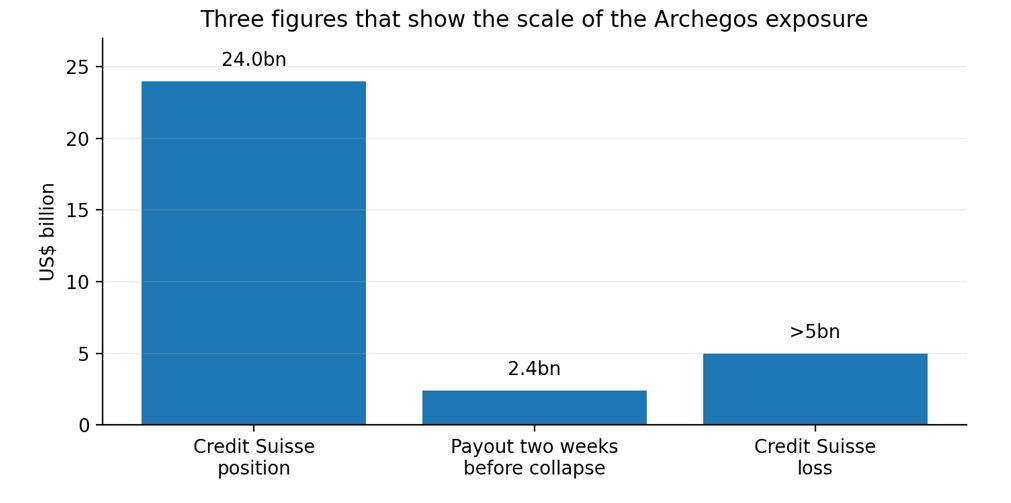
FINMA later found that Credit Suisse’s own position arising from the Archegos relationship had reached US$24 billion in March 2021—four times the position linked to its next-largest hedge-fund client and more than half of Credit Suisse Group’s equity. Two weeks before the collapse, Credit Suisse paid Archegos US$2.4 billion. After the unwind, Credit Suisse suffered a loss of more than US$5 billion.
The most important failure was not the absence of risk indicators. Credit Suisse’s monitoring repeatedly showed that limits had been exceeded. According to FINMA, the response was often to raise the limits rather than materially reduce the exposure or demand sufficient additional collateral. The case shows that a risk framework is only as strong as the action triggered by a breach.
6. What Should Investors Look For?
Historical returns remain important, but they should be the beginning of fund analysis rather than the conclusion. The table below contrasts several signs of a disciplined framework with common warning signals.

One question brings these issues together: What would have to happen for this fund to become a forced seller? A useful answer should identify the relevant market movement, collateral requirement, investor cash demand or liquidity constraint, and explain what preventive measures are already in place. If the manager cannot answer clearly, the portfolio risk is unlikely to be fully understood.
7. Bottom Line
Risk management does not make investing safe. It makes risk survivable. A diversified-looking portfolio can still depend on one common factor. A strong investment idea can still cause serious damage when the position is too large or the financing is too fragile. A hedge can create value even when its main contribution is preserving liquidity and decision-making freedom. The Archegos collapse also shows how concentrated synthetic exposures, insufficient margin and ineffective responses to repeated limit breaches can turn a client position into a multibillion-dollar loss.
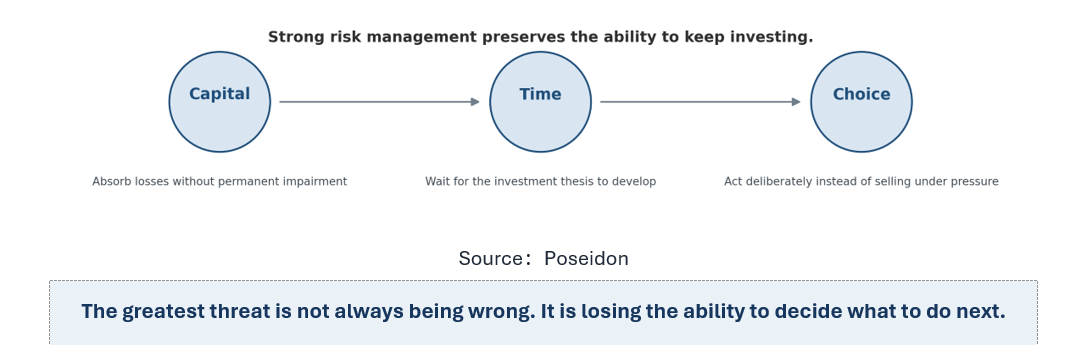
Strong funds accept that some positions will lose money. They size those positions so the losses remain manageable, limit leverage so lenders do not determine the exit, maintain enough liquidity to meet obligations and use independent controls to keep implementation aligned with the investment thesis.
Investors should therefore ask not only, “How much did the fund return?” but also, “What risks produced that return, and would the fund remain in control if those risks moved against it?” Returns measure what a fund achieved when its strategy worked. Risk management shows whether it will still be able to invest when the strategy—or the market—does not.

