The Dollar That Pays You Nothing — Inside the Reserve War Behind Stablecoins

In July 2026, the GENIUS Act turned one year old without a single final rule in force — yet the market it was written to govern had already swelled past $300 billion, larger than the foreign-exchange reserves of most nations on earth. Into that regulatory vacuum stepped an unlikely crowd. Not crypto start-ups, but the most established names in traditional asset management — BlackRock, Goldman Sachs, State Street, Fidelity, BNY, Invesco — each racing to stake a claim. The strange part is what they were racing for. Not one of them wanted to issue a stablecoin. Every one of them wanted to hold what sits behind it.
At the same moment, Washington was tearing itself apart over a question that sounds like a technicality: can a stablecoin pay interest to the person who holds it? The week of 29 June, Coinbase abruptly pulled its support for a digital-asset bill it had championed for two years, a Senate markup was postponed, and the President publicly attacked the banks lobbying against stablecoin yield. A single word — "yield" — had stalled the most important crypto legislation in a decade.
Why would the world's largest asset managers fight to manage a pile of Treasury bills, and Washington's most powerful lobbies fight over who may earn interest on them? Because a stablecoin is not really a crypto story. It is a claim on a reserve, and whoever holds that reserve collects a risk-free return measured in the billions. The token is marketing; the reserve is business. What follows is a look inside the machine — how the money is made, who quietly wins, and why a $300 billion pile of digital dollars has become a force in both the US Treasury market and the deposit base of the banking system.
1. The product in one sentence: a bearer claim that pays its holder nothing
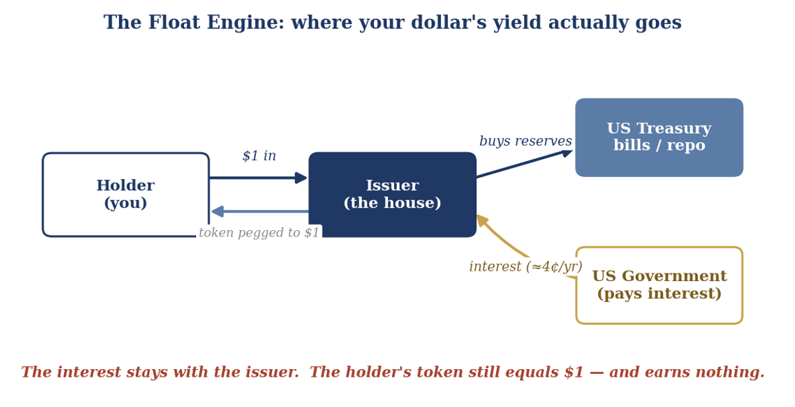
A stablecoin is a dollar you lend to the issuer for free. You hand over one dollar; the issuer hands back a redeemable token at par and keeps every cent that your dollar goes on to earn.
The mechanics are deliberately plain. The issuer takes the customer's dollar, parks it in short-dated US Treasury bills, repo and cash equivalents, and returns a token that trades at $1 and can be redeemed for $1. That reserve is not idle. At the short-term rates prevailing in 2026, it throws off roughly four cents a year on every dollar — interest paid, in effect, by the US government to the issuer. The holder receives none of it. What they get is the convenience of a dollar that moves at internet speed; what they give up is the yield that dollar would have earned in their own hands.
This is not an accident of design — it is the design, now written into law. The GENIUS Act mandates that every payment stablecoin be backed one-for-one by high-quality liquid assets and expressly forbids issuers from paying any interest or yield to holders. The float — the pool of customer dollars and the income it generates — stays with the issuer by statute. That single provision is the engine of the entire business, and, as we will see, the reason Washington nearly came to blow.
2. How the machine actually works: the float engine
Strip away the blockchain, and a stablecoin issuer is something the financial world has seen before: a money market fund that keeps the yield instead of passing it on.
What happens when a coin is minted. Direct minting and redemption are wholesale privileges, not retail ones. Only institutions that have cleared the issuer's KYC and AML onboarding — banks, exchanges, market makers — can create new coins by delivering dollars or destroy them by redeeming for dollars. Everyone else buys and sells on the secondary market. The consequence is mechanical and important: every dollar minted forces the issuer to buy a dollar of reserves. Demand for the coin translates, one-for-one, into demand for Treasury bills.
Where the money sits. The scale is now considerable. Tether's Q1 2026 attestation showed a reserve base of roughly $192 billion against about $183 billion of tokens in circulation, with the bulk — around $117 billion — held directly in Treasury bills and a further slice in Treasury-collateralized reverse repo. Circle runs the same playbook through a more institutional pipe: its USDC reserves are managed by BlackRock and custodied at BNY Mellon, with the large majority linked to Treasuries through direct holdings and repo. Two firms, between them commanding the great majority of the market, have quietly become among the most significant buyers of short-term US government debt on the planet.

Where the profit comes from. This is where the numbers stop being abstract. Tether reported over a billion dollars of net profit in the first quarter of 2026 alone; across 2025, on a reserve base of roughly $187 billion earning 4–5%, it earned north of ten billion dollars — almost entirely from Treasury yield. The margin structure is the tell: because the raw material (customer dollars) is free and the cost of holding Treasuries is trivial, the business converts scale into profit with almost no friction. Circle earns the same reserve income but shares roughly half of it with its distribution partner, Coinbase — which is why, despite billions in revenue, its net margin looks comparatively thin. The lesson is that the economics flow to whoever controls the reserve and the distribution, not merely to whoever's name is on the coin.
The property that makes it powerful — and rigid. A hedge fund or a money market trader buys Treasuries when they are cheap and sells when they are dear. A stablecoin issuer cannot. It must hold reserves against every coin outstanding, regardless of price or yield. Its demand for Treasury bills is, in the language of markets, price-inelastic: it buys because a coin was minted, not because the yield is attractive. That rigidity is what turns a payments product into a market force — a point we return to in Section 4.
3. The house's secret: who really wins
Return to the arrangement and look at who bears what. The holder takes the risk that the peg breaks, the risk that the issuer's reserves are not what they claim, and the certainty of earning nothing. The issuer takes the customer's dollar, lends it to the US government, and keeps the interest. It is, on inspection, one of the strange bargains in modern finance: millions of holders collectively finance a float of hundreds of billions of dollars, and the entire risk-free return on that float accrues to the issuer and its distribution partners.
The structure rhymes with something we have written about before — the dealer behind a leveraged ETF, who runs a mechanical, predictable book and collects a steady stream of fees while the buyer carries the risk. Here the issuer is the house. Its book is about as predictable as a book can be: dollars come in, Treasuries get bought, coupons roll in. The holder supplies the capital and absorbs the tail risk; the house clips the coupon.
But the house has a vulnerability, and it is worth naming plainly: this is a leveraged bet on interest rates staying high. Because revenue is almost entirely Treasury yield, every cut the Federal Reserve makes flows straight through to the bottom line. Model minting billions at 5% short rates is a very different business at 2%. The float engine runs hot when rates are high and cools precisely when they fall — a sensitivity that is invisible in a bull market and unforgiving in an easing cycle.

None of this is unprecedented. Money market funds grew from nothing in 1971 to hundreds of billions by the early 1980s, offering savers a market yield that bank deposits, then capped by regulation, could not match. Money drained out of the banking system, a phenomenon that acquired its own name — disintermediation — and the banking industry warned Congress that credit would dry up. The same script is being read again, with a new cast. Which brings us to why the stakes reach well beyond crypto.
4. When the float moves the market: two systemic fault lines
At over $300 billion, stablecoin reserves have stopped being a curiosity at the edge of finance and become a structural presence at its center — with pressure landing on two very different markets at once.
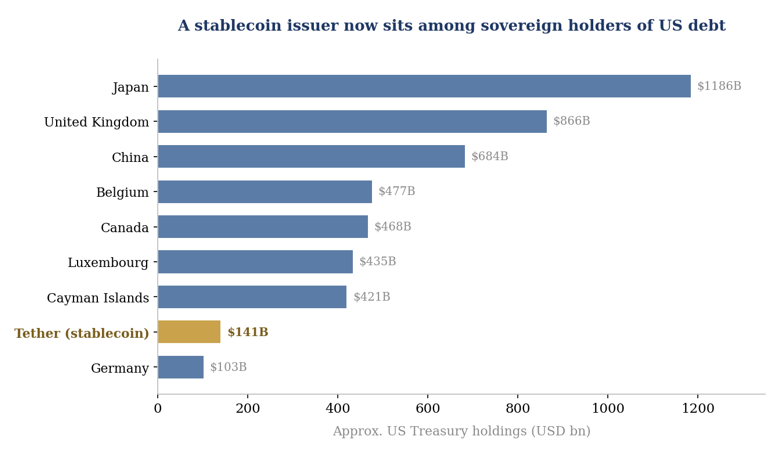
The Treasury channel. The stablecoin market crossed $320 billion at its 2026 peak, a sum that exceeds the foreign-exchange reserves of the great majority of countries. Tether alone holds enough US government debt to rank among the largest holders of US Treasuries in the world — ahead of countries like Germany. That size, combined with the price-inelastic buying described above, has a measurable effect on prices. Landmark papers from the IMF and the Bank for International Settlements now quantify what fixed-income desks had suspected: stablecoin reserve demand is compressing short-term Treasury yields, and the effect strengthens as the sector grows larger and more embedded. A payments technology has, almost as a side effect, become a factor in the pricing of the world's most important risk-free assets.
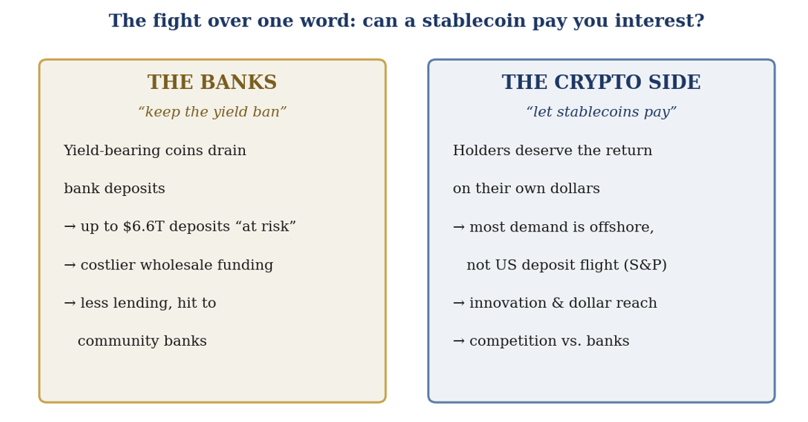
The deposit channel — the bank fight. This is where the interest-payment question turns from technical to existential. A US Treasury advisory body has flagged roughly $6.6 trillion of transactional bank deposits as potentially "at risk" of migrating toward stablecoins; Citigroup projects the stablecoin market could reach anywhere from $0.5 to $3.7 trillion by 2030, displacing hundreds of billions of dollars of bank deposits along the way. The mechanism is exactly the one from the 1980s: the moment a stablecoin can offer a competitive return, it stops being a payment tool and becomes a substitute for a low-yield deposit. Deposits are what banks lend against; drain them, and banks must fund themselves in costlier wholesale markets and pull back on lending — a squeeze that falls hardest on community banks and the borrowers who depend on them. That is why the banking lobby fought so hard for the yield ban, and why it guards it so fiercely now.
Why serious people disagree. It would be tidy to declare one side right, but the evidence genuinely splits. S&P notes that most stablecoin demand today originates outside the United States — dollar hunger in emerging markets, not deposit flight in Ohio — which limits the immediate threat to domestic deposits even as it keeps generating Treasury demand. Federal Reserve and academic models, by contrast, find that domestic stablecoin adoption does directly reduce bank deposits, and that permitting yield would sharply intensify the effect. The honest reading is that the outcome depends on a policy choice not yet made: whether, and how, the yield door is allowed to open. That choice is the live fault line running through Washington right now.
5. So how should a private client think about it?
For a family office or private client, the practical translation is unglamorous but clarifying: treat a stablecoin as what it mechanically is — a share in an unremunerated money market fund, with peg risk, custody risk and regulatory-arbitrage risk layered on top.
What it is genuinely good for. Settlement and cross-border transfer at a speed and cost the correspondent-banking system cannot match; on- and off-ramp liquidity for digital-asset activity; parking operational working capital in a dollar instrument that moves around the clock. For these jobs the stablecoin earns its place.
What you are giving up. Precisely the yield you would earn holding the Treasury bills yourself. The issuer's profit is, to the dollar, your foregone return. Holding a large idle balance in a stablecoin is a decision to donate your interest to the issuer — defensible for working balances, harder to justify for a store of value. Notably, the market is already voting with its feet: capital has begun rotating out of non-yielding payment stablecoins and into yield-bearing tokenized Treasury products, which hand the coupon back to the holder.
The risks that matter at this level. Reserve quality and the gap between an attestation and a full audit — most issuer reports are the former, a point-in-time snapshot that assumes orderly markets, not the latter. Issuer concentration in a market where two names dominate. And an asymmetry that only bites in a crisis: institutions can redeem directly at par, while everyone else must sell into the secondary market, where the price in a panic is whatever a buyer will pay. The peg holds until, precisely when you need it, it is tested.
The alternative the banks are building. Watch the tokenized-deposit response. Banks are countering stablecoins with tokenized versions of ordinary deposits, and the structural difference matters more than the shared "digital dollar" label: a tokenized deposit is bank money, sitting behind deposit insurance and central-bank backstops, whereas a stablecoin is a bearer claim on a private reserve pool with neither. For a client weighing where to hold digital dollars, that distinction is the whole game.
6. Bottom line
The stablecoin is not the product. The reserve is. Everything that looks like a crypto story on the surface — the tokens, the exchanges, the legislative drama — resolves, on inspection, into an old and familiar contest over who gets to hold a pile of dollars and keep the interest.
That is why six of the world's largest asset managers are racing in, and why the banking lobby is fighting to hold the line: both understand that the prize is the risk-free carry on the float, not the coin on the screen. And it is why 2026 is best understood not as the year stablecoins went mainstream, but as the year the financial system began fighting in earnest over who is allowed to hold the reserve behind them.
For an investor holding a stablecoin, the question is finally quite simple. Am I comfortable lending my dollar to this issuer for free — and do I trust the reserve behind it more than I would value the yield I am giving up? Answer that, and you understand the product better than most of the market does.

