Beyond the Discount — Recent Trends in PE secondaries

1 Where we left off
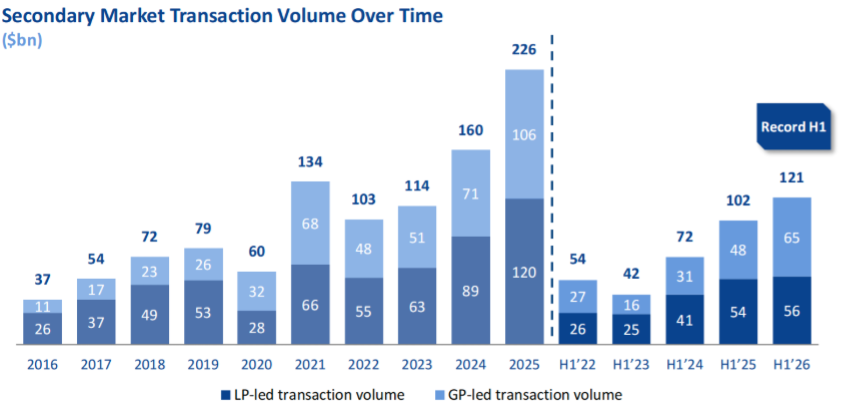
In 2024, in our piece Poseidon Partner - Foresights - The Secondary Market of Primary Market, we introduced the characteristics and the evolution of Private Equity Secondary Funds. Two and a half years later the market has roughly doubled. Evercore puts 2025 volume at approximately $226 billion, up more than 40%, and the first half of 2026 at $121 billion, a single half-year larger than the whole of 2022. Full-year 2026 is tracking toward $250–260 billion.
Growth alone is not the interesting part. What matters is that the composition changed, and in ways that affect what an investor ends up owning. Three shifts stand out.
Transactions are increasingly arranged by managers, not investors. GP-led deals reached $65 billion in the first half, up 35%, against $56 billion for LP-led sales, up 4%. GP-led now accounts for 54% of the market, against 47% for 2025.
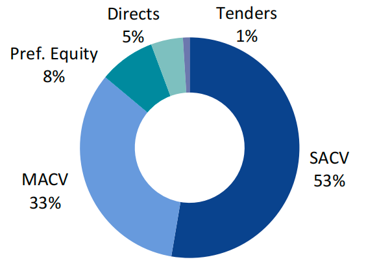
Within GP-led transactions, the dominant trend is increasingly a single company rather than a portfolio. Single-asset continuation vehicles grew 88% to $34 billion and represented 53% of GP-led volume, making them the largest transaction type in the market.
Technology has cooled while remain importance. It remains the largest sector in GP-led activity, but the incremental dollar has moved toward infrastructure, credit, industrials and healthcare.
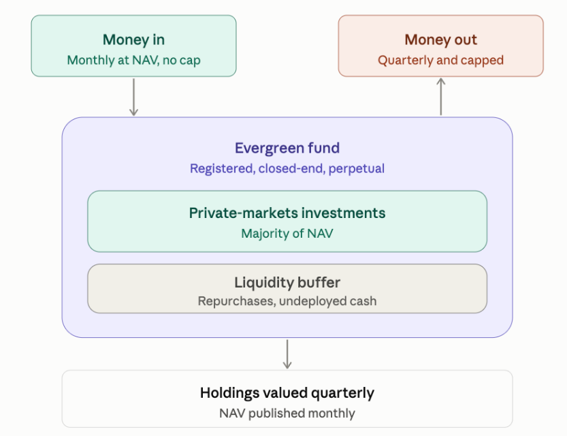
Alongside these, the way private investors reach the asset class has changed. Semi-liquid evergreen vehicles, funds that accept subscriptions monthly and offer limited quarterly redemptions, have gone from a niche product to a standing feature of the market. More than half of active secondary buyers now operate one. A well-funded buyer base, together with the need to deploy continuous evergreen inflows, is also increasing competition for high-quality assets and keeping prices closer to NAV.
Each of these developments has a straightforward implication. Taken together they change the honest answer to a simple question: what are investors buying, and what should investors expect from it?
2 What is being bought
2.1 GP-led deal has become a more prevalent trend.
According to Evercore’s report, GP-led volume reached $65 billion in 26H1, up 35% from last year, and for the first time made up the majority of the market at 54%.
In an LP-led transaction, a buyer acquires fund interests or portfolios selected for sale by an existing investor. The buyer’s exposure is therefore largely determined by the assets already held in those funds.
In a GP-led transaction, the manager transfers one or more portfolio companies from an existing fund into a new continuation vehicle. Existing investors can either sell their interests or remain invested, while new buyers provide capital to the vehicle.
This gives secondary buyers more targeted exposure and allows them to underwrite the selected assets in greater detail. The GP still determines which assets are brought to market, but buyers are no longer limited to acquiring a broad portfolio assembled for reasons unrelated to their own investment strategy.
2.2 Single Asset Continuation Vehicle (SACV) is showing a greater portion
Single-asset continuation vehicles have become the largest transaction type in the secondary market. A SACV separates one portfolio company from an existing fund and places it into a new vehicle, allowing the sponsor to hold the company for longer and raise additional capital for its next phase of development.
For buyers, the main benefit is greater focus. Rather than acquiring an entire fund or a diversified portfolio containing both attractive and less attractive exposures, investors can underwrite a specific company in greater depth and direct capital toward an asset in which they have higher conviction.
However, the same selectivity can reduce the buyer’s bargaining power. In an LP-led portfolio transaction, the buyer may demand a discount for taking on complexity, older assets or exposures it would not have selected independently. A SACV removes much of that unwanted inventory. The asset is usually selected by the sponsor, marketed as one of the stronger companies in the existing fund and offered through a competitive process to buyers evaluating the same scarce opportunity.
As a result, buyers gain greater precision in asset selection but lose part of the discount associated with buying a broader portfolio. Around two-thirds of single-asset continuation vehicles have traded at or above NAV, indicating that buyers are often competing for access rather than being compensated for absorbing unwanted assets. When headline pricing is already close to par, negotiation may shift toward governance rights, fees, carried interest, downside protection and the sponsor’s continued economic alignment.
Each coin has two sides. SACVs allow capital to be concentrated in assets with stronger perceived value-creation potential, but they also increase concentration and place more of the investment outcome on the performance of a single company. Buyers give up some diversification, entry discount and price leverage in exchange for greater asset-level visibility and selectivity.
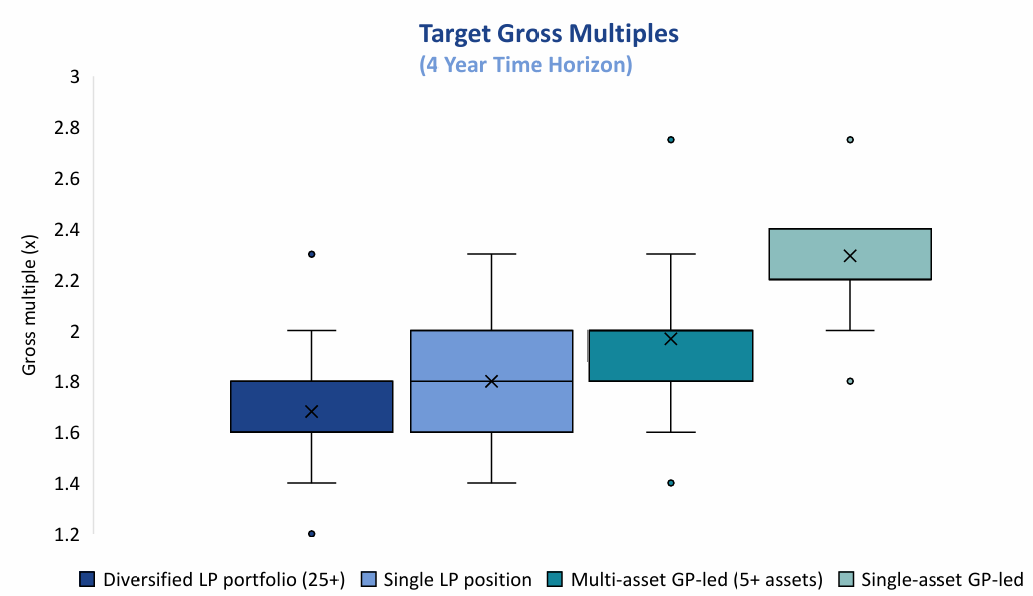
Evercore estimates that a single-asset GP-led transaction could generate a gross value of around 2.3 times the capital invested over four years. In simple terms, every $1 invested is expected to become $2.30 before management fees and carried interest. This is like TVPI, which measures the total value of an investment, including both cash already returned and the value of assets still held, divided by the capital invested. The equivalent targets are 1.9x for multi-asset continuation vehicles and 1.7x for diversified LP portfolios. The target is higher for single-asset deals because buyers usually receive less of an entry discount and must rely more on the company’s future growth to generate returns.
2.3 Where the sectors moved
Technology was the leading sector in GP-led transactions through the end of 2025. Frequent financing rounds and rising valuations provided recent reference points that helped buyers price private technology assets.
The market changed in the first half of 2026. Concerns about the impact of AI on software business models weakened public software valuations and made private-company earnings more difficult to assess. Software continuation vehicles fell from 18% to 10% of GP-led volume, while venture-secondary activity remained broadly flat.
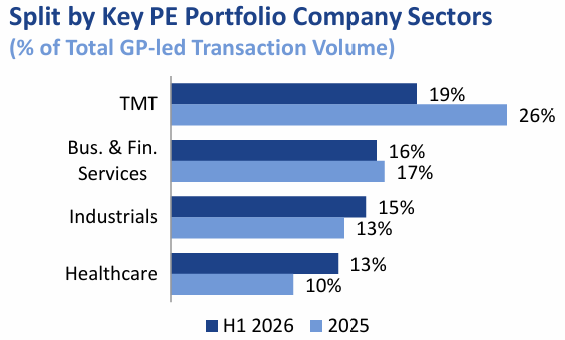
Technology nevertheless remained the largest sector, accounting for 19% of GP-led volume. The change was therefore not an exit from technology, but a shift in incremental capital toward sectors with more visible cash flows. Infrastructure increased from 4% to 16% of GP-led activity, credit secondaries reached $20 billion of deal value, and industrials and healthcare also gained share.
3 What has changed for the investor
3.1 Semi-liquid access, and what it does and does not solve
Historically, reaching this asset class required a closed-end commitment: a signed obligation, capital calls over 3 to 5 years, and a decade before the position was resolved. That structure suits institutions with dedicated staff. It suits private investors far less well.
Take StepStone Private Venture and Growth Fund (SPRING) as an example: semi-liquid; subscriptions monthly; redemptions quarterly, capped at 2.5% of shares. Its June 2026 fact card shows interests in more than 2,000 portfolio companies across 108 managers — 64% secondaries, 32% primary direct investments, 4% primary funds.
Three differences from a closed-end fund matter more than the rest.
Capital is invested from day one. There are no capital calls to model and no undrawn commitment to manage. That is a genuine convenience, and it removes the single most common source of administrative error for private investors.
Entry and exit are asymmetric. Money enters monthly and uncapped. Money leaves quarterly and rationed. At 2.5% per quarter, a full exit takes roughly a decade even if every request is met — and the cap binds hardest precisely when the most people want out.
The reporting clock and the valuation clock differ. SPRING's own disclosure states that valuation of the fund's investments is ordinarily made quarterly, while the fund provides valuations and issues shares monthly. This is worth sitting with, because it explains something that otherwise looks remarkable. Since inception in November 2022 the fund has reported four negative months, the worst of them −0.48%, and a standard deviation of 8.51% against 17.90% for the Nasdaq Composite. That smoothness is real in the reporting, but it reflects how often the assets are valued rather than how much they move.
3.2 Dry powder, deployment pressure, and pricing
Dry powder, uncalled committed capital, stood at approximately $194 billion, down 10% from the start of the year. This is equivalent to roughly one year of transaction volume, which Evercore describes as healthy but not abundant.
Deployment pressure varies by structure. In closed-end funds, capital remains with investors until called, allowing managers to wait. In evergreen vehicles, subscriptions arrive as cash, and holding too much cash can dilute returns. Managers therefore have a stronger incentive to deploy capital promptly.
This supports deeper markets, faster execution and better price discovery. However, competition for high-quality assets also reduces discounts. In 2025, evergreen vehicles paid an average 89.8% of NAV for LP portfolios, compared with 86.4% for the market—a premium of 334 bps.
Capital is also selective. Tail-end funds have traded at around 70% of NAV since 2022, yet account for only about a quarter of LP-led volume. Around 70% instead goes to funds aged 3 to 8 years, which trade much closer to NAV.
Buyers are not simply looking for the largest discounts; they are prioritising assets they can assess with confidence and expect to grow further.
4 What investors should expect — and what they should not assume
Reasonable expectations. Access to companies and managers that may otherwise be difficult to reach, at prices determined through competitive processes. Immediate exposure to an existing portfolio rather than a position built gradually through capital calls over several years. Meaningful diversification across vintages, managers and strategies, particularly in multi-asset structures. Regular reporting and simpler administration.
What investors should not assume. Investors should not assume that discounts will be the main driver of returns, because performance increasingly depends on the underlying assets. They should not assume that every secondary vehicle provides diversification, since single-asset structures are intentionally concentrated. Smooth reported returns should not be interpreted as evidence of low risk, as part of that stability reflects the quarterly valuation of private holdings. Quarterly repurchases should also not be treated as guaranteed liquidity, because they remain subject to redemption caps, available cash and board discretion.
Four questions are worth asking before investing in any vehicle in this market. What is the valuation date of the underlying holdings, and how far does it lag the published NAV? What was paid relative to reference-date NAV over the past twelve months, and which vintages were acquired? What do the ten largest positions represent on a look-through basis? And when was the repurchase, limit last tested, and how were investor requests handled?
The structure improves access to private markets, but the investment outcome still depends on asset selection, pricing and manager execution.
5 In closing
PE secondaries are no longer primarily a market for buying distressed portfolios at broad discounts. They are increasingly shaped by permanent capital, GP-led transactions priced close to NAV, and individual assets whose returns depend more on future operating performance than on entry discounts.
The easier it becomes to access and trade an illiquid asset, the more important it is to remember that the asset itself has not become liquid. Investors should treat them as long-term private-market allocations and focus on what the fund owns, what it paid, how valuations are produced, and whether its redemption mechanism has ever been tested.
One last note - investors should be mindful on exposure to this asset class to ensure the upside potential and liquidity constraints of such allocation is being taken into consideration properly.

