Is the Era of One-Tap Offshore Trading Coming to an End?

For many mainland investors, buying Hong Kong and U.S. stocks has become almost as easy as using a regular app: opening an account online, checking real-time quotes, joining community discussions, and placing a trade in just a few taps. Platforms such as Futu, Tiger Brokers, and Longbridge grew rapidly on the back of this low-friction user experience.
But on May 22, 2026, Chinese regulators sent a clear message: trading can become more convenient, but financial services cannot bypass licensing requirements. The China Securities Regulatory Commission disclosed that it had launched investigations into Futu, Tiger Brokers, Longbridge, and related entities for allegedly conducting securities business illegally in mainland China, and had issued administrative penalty advance notices. On the same day, the CSRC and seven other government departments released a rectification plan, proposing a two-year campaign to address illegal cross-border securities, futures, and fund business activities.
The key point is not simply that several online brokers are facing regulatory scrutiny. Rather, the boundary for cross-border online financial services is being redrawn. The core question going forward is not whether mainland investors still have offshore allocation demand, but which compliant channels will absorb that demand.
1. From Convenience to Compliance
Over the past few years, online brokers’ core advantage has been convenience. They lowered the barriers to account opening, trading, market information, and user interaction. For retail investors, the experience was fast, simple, and intuitive.
But this model also raised an important question: when the client is in mainland China, the license is offshore, and the service is delivered through an app, how should this activity be regulated?
The latest regulatory action provides a clearer answer. Cross-border securities, futures, and fund services provided to mainland investors need to be conducted through approved, licensed, and compliant channels. In other words, the industry is moving from a “convenience-first” model to a “compliance-first” model.

2. What Is the Regulation Really Targeting?
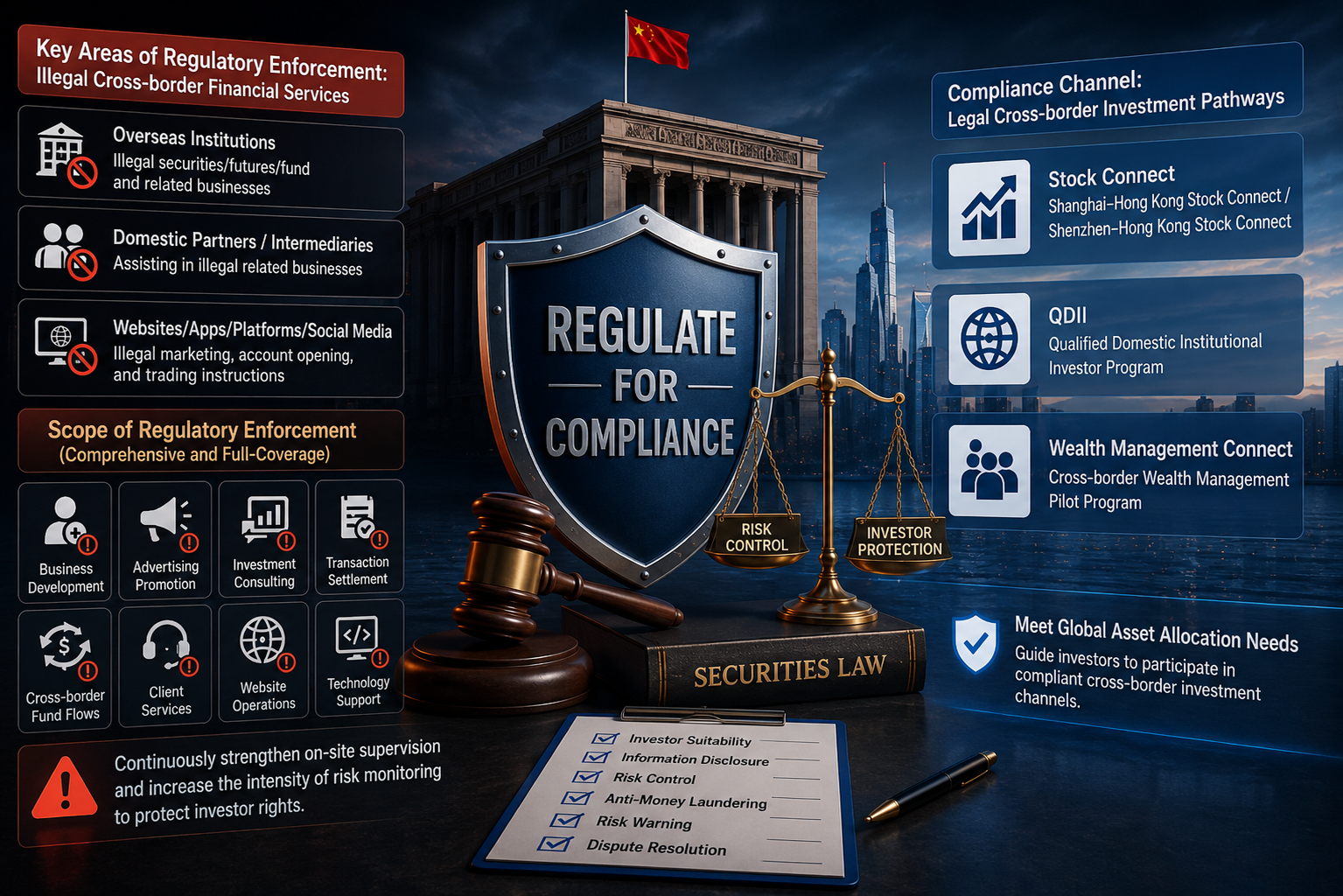
According to the CSRC’s May 22, 2026 announcement and the rectification plan jointly issued by the CSRC and seven other government departments, the rectification covers several types of participants: offshore institutions illegally conducting cross-border securities, futures, or fund businesses; onshore affiliates and intermediaries assisting those activities; and websites, apps, platforms, or social media accounts that provide marketing, account-opening links, or trading facilitation.
The scope is broad. It covers not only account opening, but also marketing, investment information push, trade order processing, fund transfer support, customer service, website operation, and technical support.
The logic is straightforward. Securities brokerage, margin financing, fund distribution, and futures brokerage are all highly regulated activities. They involve investor suitability, fund safety, anti-money laundering, data protection, and dispute resolution. If these activities bypass the domestic licensing framework, regulators face greater difficulty in monitoring risks and protecting investors.
At the same time, compliant channels still exist. The regulatory documents mention that mainland investors should be guided to use legal channels such as Stock Connect, the Qualified Domestic Institutional Investor (QDII) scheme, and Wealth Management Connect for offshore investment. This shows that the policy is not against global asset allocation. It is against unlicensed cross-border financial services targeting mainland investors.
3. Why Compliant Channels Are Likely to Gain More Market Share?
3.1 Offshore Allocation Demand Still Exists
Mainland investors, especially high-net-worth clients, still have strong offshore allocation needs. These include asset diversification, currency diversification, overseas education, business internationalization, family succession planning, and access to global market opportunities.
These needs are long-term in nature and will not disappear simply because one type of platform faces regulatory pressure. What changes is the path through which clients access offshore markets.
Going forward, clients are likely to rely more on Stock Connect, QDII products, Wealth Management Connect, Hong Kong-licensed brokers, bank wealth management platforms, private banks, foreign banks, and other wealth management institutions with compliant cross-border service capabilities.
This creates an important opportunity for institutions that can provide both offshore product access and regulatory clarity.
3.2 Banks, Private Banks, and Licensed Brokers Are Better Positioned to Benefit
For banks and private banks, this shift is particularly important. Their strengths are not limited to product distribution. They also include account infrastructure, client due diligence, source-of-funds checks, foreign exchange compliance, anti-money laundering, risk assessment, and suitability management.
As clients become more aware of regulatory and compliance risks, these capabilities will become increasingly important. In this environment, the opportunity is not simply to capture trading volume, but to become a trusted channel for clients to allocate offshore assets in a more transparent and sustainable way.
Hong Kong-licensed brokers and wealth management platforms are also better positioned to benefit. Hong Kong remains an important bridge between mainland China and international capital markets. If non-compliant online channels are compressed, clients with appropriate account structures, compliant sources of funds, and suitable investor profiles can still access global markets through Hong Kong-licensed institutions.
However, compliant institutions also need to improve the user experience. Online brokers grew quickly because they solved real client pain points, including speed, convenience, interface, pricing, and accessibility. If banks and licensed institutions want to absorb more demand, they cannot rely on “compliance” alone. They also need to provide a competitive client experience.

4. HNW Clients: Compliance Becomes Part of Wealth Planning
4.1 From “How Fast Can I Trade?” to “Is My Structure Compliant?”
One important impact of this regulatory action is that compliance awareness among high-net-worth clients will increase.
In the past, many investors focused more on convenience: how quickly they could open an account, how low the trading cost was, and how easily they could access offshore markets. After this regulatory action, more clients will begin to focus on a different set of questions.
Is the account structure compliant? Is the source of funds clearly documented? Is the product suitable for me? Is the service provider licensed in the relevant jurisdiction? Could future regulatory changes affect my ability to trade, hold assets, or transfer funds?
This mindset shift is important for the wealth management industry. For HNW clients, offshore allocation is not only about accessing markets. It is also about building a wealth structure that is stable, transparent, and defensible from a compliance perspective.
4.2 A Bigger Role for Family Offices and Private Banks
For family office and private banks, this creates an opportunity to move the client conversation beyond product performance and toward a more complete wealth structuring discussion.
The value proposition going forward will increasingly lie in helping clients build clearer and more robust cross-border wealth structures. This includes reviewing account setup, source-of-funds documentation, investor suitability, product allocation, reporting requirements, and long-term succession planning.
In other words, compliance is no longer just a back-office administrative requirement. It becomes part of client advisory and wealth planning. Institutions that can explain these issues clearly and help clients navigate them effectively will find it easier to win the trust of HNW and family office clients.
This also means that cross-border wealth management becomes more advisory-led. Competition among institutions will no longer be only about providing offshore products, but about whether they can provide a complete, compliant, well-documented, and sustainable wealth management framework.

5. Industry Transformation: From Platform Traffic to Trusted Infrastructure
5.1 Pressure on Grey-Area Cross-Border Platform Models
For online brokers, this regulatory action will lead the market to reassess their growth model. Platforms that previously relied more heavily on mainland client acquisition, high trading frequency, and fast online onboarding are likely to face pressure on new user growth, trading activity, and client asset retention.
The issue is not that technology or user experience no longer matters. They still matter. But if the underlying client acquisition and service model cannot clearly meet regulatory requirements, technology and user experience alone are no longer enough.
From a valuation perspective, online brokers are unlikely to be valued purely as high-growth internet platforms. Instead, they will be viewed more as regulated financial institutions. Investors will pay closer attention to licensing boundaries, client geography, revenue quality, compliance costs, and regulatory uncertainty.
5.2 Online Brokers’ Growth Logic Is Being Repriced
This does not mean online brokers have no future. Some platforms still have strong technology capabilities, product capabilities, and offshore operating experience. They can continue to serve clients in licensed jurisdictions such as Hong Kong, Singapore, and the United States, and also develop wealth management, corporate services, and institutional businesses.
The key question is whether they can move away from a traffic-driven model and shift toward a model that is more aligned with regulatory requirements across different jurisdictions and more centered on compliance.
For the broader industry, the direction is becoming clearer: value is shifting from platforms that “make trading easier” to institutions that “make cross-border wealth management both convenient and compliant.”
6. Investment Implications
6.1 Watch Online Brokers’ Revenue Exposure
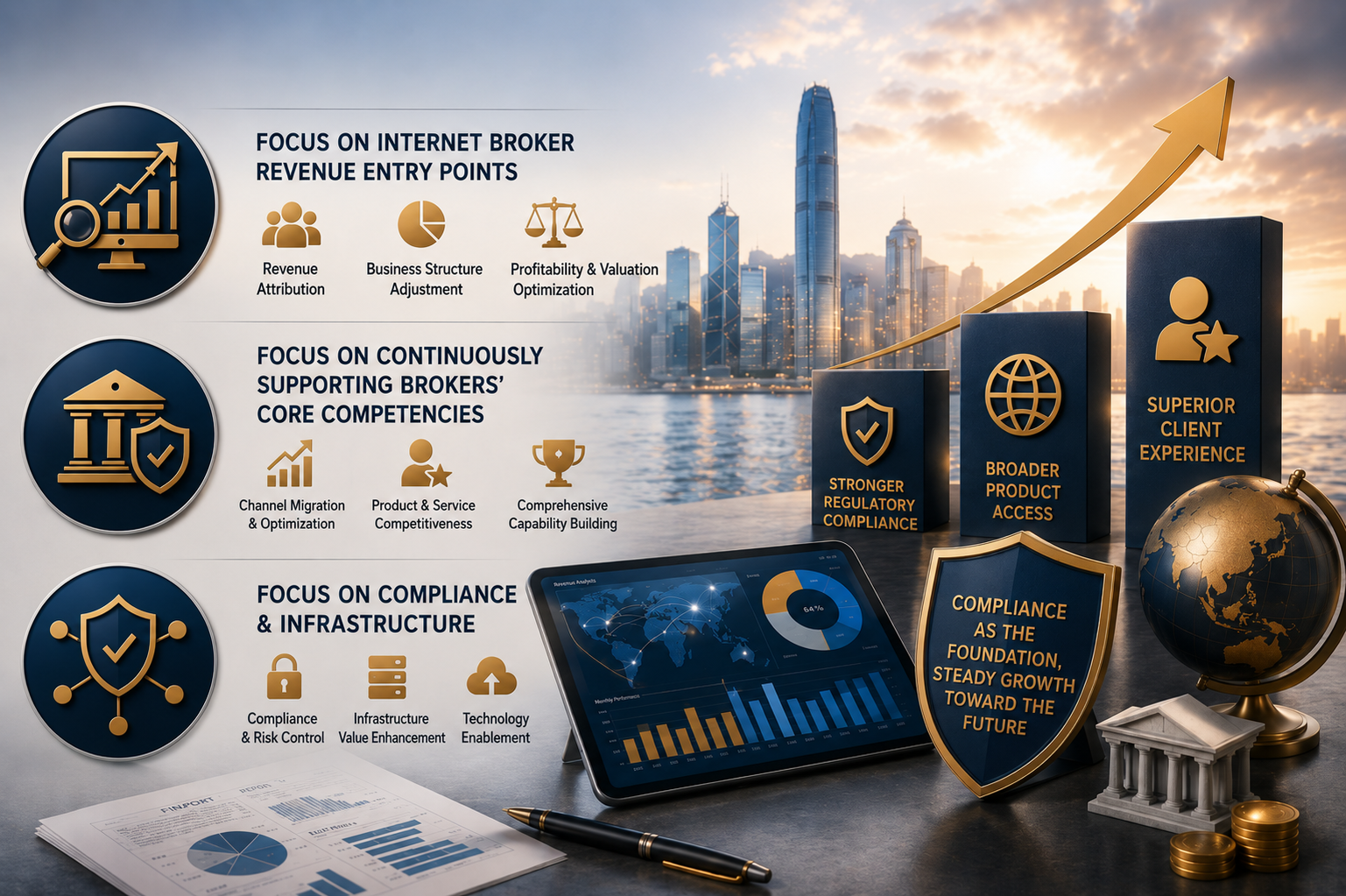
For investors, the first area to watch is online brokers’ revenue exposure to affected mainland-related businesses.
If a platform’s client growth and revenue are highly dependent on mainland investors, or if a meaningful portion of its revenue comes from trading commissions, margin financing, or wealth management product sales from affected clients, its earnings expectations and valuation multiple will likely need to be reassessed.
Investors should also watch whether platforms can adjust their business structure in time, expand in licensed jurisdictions, and develop other revenue streams.
6.2 Watch Licensed Institutions’ Ability to Absorb Demand
The second area to watch is whether licensed institutions can absorb the migrated demand.
Banks, private banks, Hong Kong-licensed brokers, fund platforms, and family office service providers are better positioned to benefit as clients migrate toward more compliant channels. But this benefit is not automatic. Clients will still care about product range, fees, execution quality, digital experience, and service efficiency.
The potential winners will be institutions that can combine three capabilities: regulatory clarity, offshore product access, and a strong client experience.
6.3 Watch Compliance Infrastructure
The third area to watch is compliance infrastructure.
As cross-border wealth management becomes more compliance-led, the value of KYC, AML, custody, account management, cross-border payments, data compliance, and regulatory technology will rise. These functions are often less visible than trading apps, but they are becoming an important foundation for the industry’s long-term development.
Therefore, the opportunity is not limited to banks and brokers. It also extends to infrastructure providers that help financial institutions serve clients in a compliant and scalable way.
That said, this transition will not happen overnight. Final regulatory arrangements, client migration speed, and the capacity of compliant channels will still influence the pace of industry adjustment.
7. Conclusion: A Compliance Reset for Cross-Border Wealth Management
The regulatory scrutiny of Futu, Tiger Brokers, and Longbridge is not an isolated event. It marks a clearer regulatory boundary for cross-border online securities services.
For online brokers, the challenge is whether they can remain competitive under a clearer licensing and compliance framework. For banks, brokers, and wealth management institutions, the opportunity is to become trusted channels for clients’ offshore allocation. For HNW clients, the signal is also clear: in cross-border wealth management, convenience matters, but compliance matters more.
The long-term impact of this regulatory action will not lie in the short-term penalty amount, but in the transformation of the industry itself. In the past, the winners were often those that could reach clients faster and make trading easier. In the future, the winners will be those that can help clients access global markets in a compliant, transparent, and sustainable way.

