Beyond Leverage: Liquidity and Financing Matter Under Market Stress
In the last week of July, three of Wall Street's largest prime brokers, Goldman Sachs, JPMorgan, and Bank of America, issued margin calls to the same hedge fund within days of each other. The fund was Situational Awareness LP (Abbreviation: SA), founded by 24-year-old former OpenAI researcher Leopold Aschenbrenner, which had grown to $45 billion in assets at its peak. The result: within days, more than $10 billion in public-market positions were force-sold, in a block trade to Citadel.
Most coverage of this event has framed the cause as “too much leverage.” That is not wrong, but it is incomplete. Leverage amplified the losses and increased the fund's sensitivity to margin calls, but it does not fully explain why the drawdown developed into a forced liquidation within days.
Two additional factors were critical: whether the fund could mobilize sufficient liquidity quickly enough to meet margin calls, and whether its financing remained workable as brokers tightened terms under stress. Leverage, liquidity, and financing all played a role, and the rest of this article examines how they interacted.
Traditional Hedges vs. AI Hedges: Different Bets
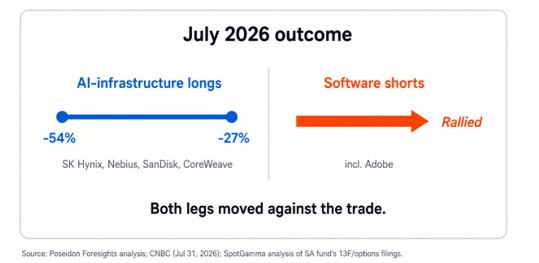
Situational Awareness's strategy wasn't complicated: roughly 4x leverage, long AI infrastructure names (SK Hynix, Nebius, SanDisk, CoreWeave, among others), short AI application-layer software (Adobe). A classic relative value trade: It's not about betting on one side to rise or fall, but rather on which side will perform better. Through July 2026, the market delivered the opposite answer. The fund's core AI-infrastructure longs each fell somewhere between 27% and 54% on the month, while its software shorts, including Adobe, rallied against it. Within about a month, both legs moved sharply against the fund at the same time.
Traditional relative-value trades are often anchored to relatively slower-moving drivers such as interest-rate cycles, earnings cycles or broader style rotations. That can give managers greater reason to tolerate a short-term dislocation while waiting for the underlying relationship to normalize. The dynamics of AI infrastructure and software can move at a much faster pace. Market consensus on which part of the AI value chain is winning can be reshaped by model releases, earnings surprises, capex guidance and rapidly changing sentiment within days or weeks. The risk is therefore not simply that an AI thesis can be wrong, but that the market can reprice the relative relationship faster than a leveraged portfolio is structurally able to wait. The deeper issue was therefore not leverage alone, but applying significant leverage to a trade whose underlying relationship could change faster than the fund's liquidity and financing structure could absorb.
Leverage Amplifies Losses, Liquidity & Financing Determine Survival
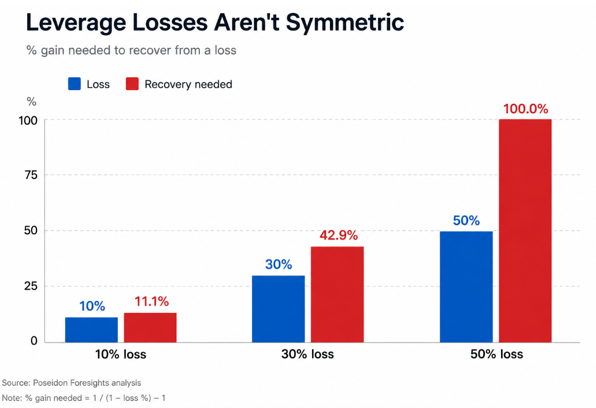
Loss recovery is inherently asymmetric. For example, a 10% loss needs an 11.1% gain to recover; a 30% loss needs 42.9%; a 50% loss needs a full double. The larger the drawdown, the harder recovery becomes. Whether that mechanism gets triggered depends less on the math and more on whether the fund can hold the position long enough to let it play out and that is a question of liquidity and financing, not leverage.
Leverage increases the speed and magnitude at which a portfolio can reach those larger drawdowns. But whether the fund is able to remain invested after the loss depends on something different: whether it can meet the associated margin requirements and maintain workable financing.
A 4x leveraged position leaves less room to absorb adverse market moves and therefore depends heavily on the fund’s ability to meet margin calls quickly and maintain financing under stress. If available liquidity cannot be mobilized within the required timeframe, or if brokers simultaneously tighten margin terms, the fund may be forced to reduce positions before the investment thesis has time to play out. In SA Fund’s case, margin calls from three major prime brokers arrived within a short period, sharply increasing its immediate liquidity needs. The key mismatch was therefore not simply leverage, but whether the fund’s liquidity buffer and financing structure were resilient enough to withstand a rapid deterioration in market conditions.
Beyond Leverage: Liquidity and Financing as Hidden Risk Levers
For leveraged funds, the headline leverage multiple tells only part of the risk story. It shows how strongly market moves can affect the portfolio, but it does not tell investors whether the fund can absorb those losses without being forced to deleverage. That depends heavily on two related factors: how much liquidity the fund can mobilize and how quickly, and how financing conditions may change when counterparties become more defensive.
Start with liquidity: Can the Fund Meet Margin Calls?
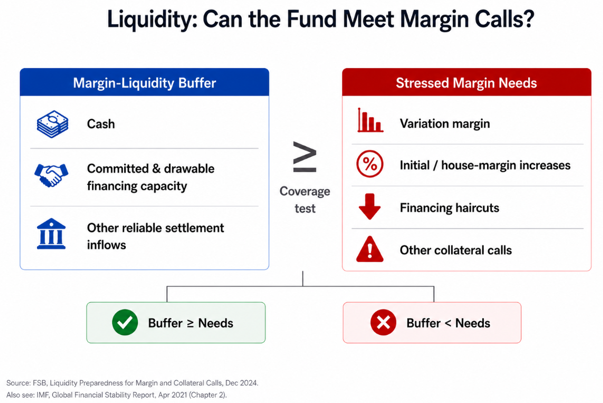
In a leveraged fund, liquidity is assessed primarily as the capacity to meet margin and collateral calls on time. The Financial Stability Board's guidance on liquidity preparedness for margin and collateral calls makes the same distinction: non-bank market participants should maintain sufficient cash and readily available liquid assets, stress-test margin needs, incorporate haircuts and operational constraints, and establish contingency funding plans for extreme but plausible scenarios.
This leads to a more precise decomposition. Asset liquidity asks whether a security can be sold without excessive price impact. Funding liquidity asks whether the fund can obtain cash when it needs it. Collateral liquidity asks whether the assets the fund holds are eligible, transferable and acceptable to counterparties after haircuts. During a margin event, the second and third categories are decisive. A highly traded equity position is not a liquidity reserve if it is already pledged, if selling it would destroy the portfolio's risk balance, or if its stressed liquidation discount becomes large exactly when cash is needed. The key issue during a margin event is therefore not simply whether an asset is “liquid,” but whether it can be converted into usable cash or collateral before the obligation falls due.
For due diligence, the most useful metric is therefore an explicit margin-liquidity buffer rather than a simple percentage of the portfolio classified as 'liquid'. An allocator can ask the manager to estimate the sum of immediately available cash, eligible collateral after haircuts, committed and genuinely drawable financing capacity, and other reliable settlement inflows. That amount can then be compared with stressed variation margin, increases in initial or house margin, financing haircuts and other collateral requirements. The practical question is simple: can sufficient resources be mobilized before the margin call is due, without forcing the fund to sell core positions under pressure?
SA Fund's case illustrates why the distinction matters. Its roughly $5 billion stake in Anthropic remained economically valuable but was not readily monetizable within the immediate margin-call horizon. Its public-market positions, by contrast, could be monetized much more quickly and therefore became the primary source of liquidity during the unwind. Portfolio value and margin liquidity are therefore not the same thing. What matters under stress is how much value can be mobilized in time.
Financing: Can the Fund Withstand a Funding Pullback?
Liquidity tells investors how much cash and eligible collateral a fund can mobilize, and how quickly. Financing determines the size and timing of the demands placed on that liquidity. SA Fund received margin calls from Goldman Sachs, JPMorgan and Bank of America within a short period.
In stressed markets, each prime broker manages its own balance sheet, collateral exposure and credit risk. When portfolio values fall or volatility rises, brokers may independently raise margin requirements, increase collateral haircuts or reduce financing capacity. As a result, several brokers can become more defensive at the same time, regardless of how many counterparties the fund uses. More prime brokers therefore do not necessarily mean safer financing. The relevant issue is whether the fund's financing structure remains workable when counterparties become more defensive at the same time.
For investors, the practical question is: can the fund withstand a broad tightening in financing conditions? A useful stress test should assume higher margin requirements, larger collateral haircuts and no incremental financing. The fund can then assess how much liquidity would be required, how much eligible collateral remains available, and whether forced asset sales would be necessary.
Financing terms also matter, including how frequently collateral is re-marked, how quickly additional margin must be posted, how haircuts can change under stress and whether committed facilities remain drawable. SA Fund’s experience also shows why these details matter: multiple margin calls within a short period sharply increased its immediate liquidity needs. The central issue was not the number of brokers, but whether the fund’s financing remained workable under stress and whether its liquidity buffer could absorb the resulting demands.
For due diligence, liquidity and financing should therefore be assessed together. Liquidity is about capacity and speed; financing is about the size and timing of the demands on that liquidity. The key test is whether the fund can mobilize sufficient resources quickly enough to withstand tighter margin and funding conditions without being forced into disorderly asset sales.
Why Liquidity and Financing Matter Beyond Leverage
SA Fund was not the only strategy affected by the sharp reversal in AI-related trades. In the weeks surrounding the broader AI-related reversal, systematic quant hedge funds recorded their weakest performance since the previous August, with year-to-date returns falling from 14.4% to 10.8%. Losses were concentrated across US equities, developed Asia, particularly Korea and European technology and semiconductor stocks, overlapping with many of the same areas in which SA Fund was exposed.
A similar pattern appeared during the summer 2025 quant sell-off, when crowded positions reversed and long-short funds reduced risk simultaneously. These episodes show that when similar leveraged portfolios are hit by the same market move, liquidity needs can rise quickly across multiple funds at the same time.
This is where liquidity and financing become critical. A portfolio loss may be manageable on its own, but the pressure can escalate if margin calls arrive quickly while brokers simultaneously raise haircuts, tighten collateral requirements or reduce financing capacity. The ability to survive a rapid market reversal therefore depends not only on leverage, but on whether liquidity can be mobilized at the same speed that financing demands increase.
SA Fund is an extreme example of a broader mechanism. For investors, the key question is not simply whether a strategy is leveraged or exposed to a crowded trade, but whether its liquidity buffer and financing arrangements can withstand a rapid, correlated market shock without forcing disorderly asset sales.
Before Allocation: Size the Risk, Then Do the Diligence
From an investor’s perspective, the key lesson is simple: due diligence matters most before capital is allocated. Once a fund is already facing margin pressure or tighter financing conditions, it is too late for investors to change the structure of the risk they have taken.
Pre-allocation due diligence should therefore go beyond headline leverage and track record. The more practical questions are how much liquidity the fund can mobilize within the required timeframe, and whether its financing remains workable when market conditions deteriorate. Strong historical performance does not answer either question; it shows how the strategy has performed in the past, but not necessarily whether the fund can withstand a rapid increase in margin and collateral requirements.
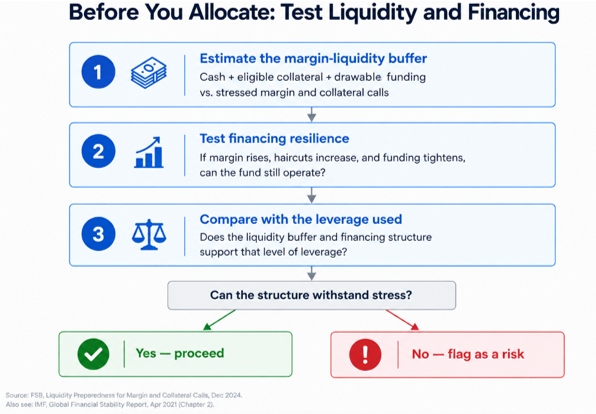
A practical due-diligence test has two parts. First, estimate the fund’s margin-liquidity buffer: immediately available cash, eligible collateral after haircuts, reliable settlement inflows, and financing that remains genuinely drawable under stress. These resources should be compared with stressed margin and collateral requirements over relevant horizons, such as one day, five days and one month.
Second, test financing resilience. Investors should examine how quickly additional margin can be called, how much haircuts and collateral requirements can increase, whether financing may become less available, and how much time the fund has to respond. The objective is not to predict the next market reversal, but to determine whether the fund can continue operating if liquidity requirements rise quickly while financing becomes less supportive.
Together, these two tests address the question that headline leverage cannot: can the fund mobilize sufficient resources quickly enough to meet rising margin demands without being forced into disorderly asset sales?
Beyond fund-level due diligence, investors should also consider the same risk at the portfolio level. AI exposure may appear across public equities, hedge funds, private equity and private credit, but these positions can still depend on similar assumptions around continued AI capital expenditure and commercialization. A portfolio that appears diversified by asset class may therefore remain materially exposed to the same underlying investment thesis.
A practical approach is to aggregate positions that rely materially on the same AI thesis and compare that exposure with the investor’s intended thematic risk limit. The concern becomes more significant when common exposures are combined with leverage, short liquidity horizons or financing that may tighten under stress.
This is not an argument for avoiding AI. The broader point is that portfolio-level concentration and fund-level liquidity and financing should be assessed together before capital is committed. Investors should understand not only how much exposure they hold, but whether the structures behind that exposure can withstand a period of market stress.
The Takeaway for Investors
Leverage determines the extent to which losses are amplified, while liquidity and financing conditions determine whether market stress ultimately leads to forced liquidation. What matters more is whether the fund can mobilize enough liquidity, quickly enough, to meet margin calls and whether its financing can remain workable as market conditions deteriorate.
SA Fund’s experience highlights two areas investors should examine closely: margin liquidity and financing resilience. A fund may hold valuable or liquid assets, but the key question is whether sufficient cash and eligible collateral can be accessed within the required timeframe. At the same time, financing can tighten rapidly as brokers raise margin requirements, increase haircuts or reduce balance-sheet support.
For investors, due diligence should therefore go beyond headline leverage and track record. It should test how much liquidity is available under stress, how quickly it can be mobilized, and whether the fund can withstand tighter financing conditions without forced selling. In leveraged strategies, liquidity and financing are not secondary risk considerations. They determine whether the fund has enough time and flexibility to remain in the market when stress arrives.

